You've Read Your Draft a Dozen Times
So Why Does It Still Not Feel Quite Right?
A step-by-step line & copyediting course for fiction writers who want to revise their manuscript to a professional standard—with personalized feedback from a professional editor—without hiring one yet.
Price: $397
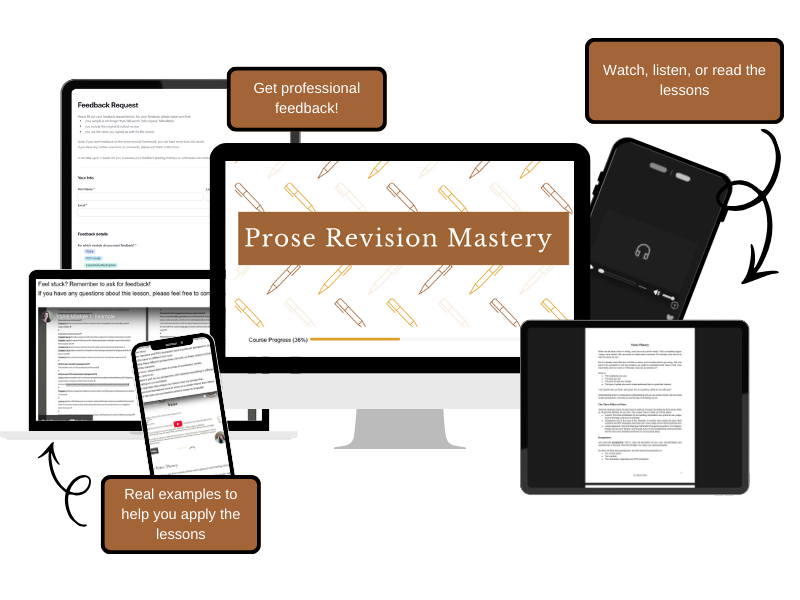
Created by a professional editor & indie author specializing in fiction. I built this course combining the real & techniques I use when I edit client novels with a clear framework I've tested on my own novels.
So You've Written a Manuscript… Now What?
Why It Feels So Hard
Writing a story and editing one are two very different skills—and almost nobody teaches the second one.
- How to build a scene.
- How to develop a character.
- How to structure a plot.
- Controlling how close or distant a reader feels from your character.
- Recognising that a verb is carrying the wrong emotional weight.
- Knowing exactly what a "filter word" is and why it creates distance.
What a Paragraph Looks Like
Through an Editorial Eye
None of these are obvious errors. The passage is grammatically correct. Once you can see these, and know what to do about them, revision stops feeling like guesswork.
What Prose Revision Mastery Is
Prose Revision Mastery is a step-by-step line and copyediting course for fiction writers. It walks you through 15 modules of specific techniques, each one applied to your own manuscript—with a professional editor reviewing your work at every step.
By the end of it, you'll have a clear, repeatable process for revising your own prose, and a chapter that reads like it's already been professionally edited to show for it.
This course is designed for fiction writers who have a draft and are ready to work at the sentence level. It's not about plot or structure—those need to be in place first. It's purely about the prose.
How It Works
Every module follows the same three-step structure.
Theory
Learn the technique and why it matters.
Example
See it applied to a real chapter before you try.
Homework & Feedback
Apply it to your manuscript, then submit for annotated review.
That last step is what makes the difference. You're working through every technique on your own writing, with a professional editor reviewing it at every stage.
The Feedback
Most courses give you the content and leave you to figure out the rest on your own. This one doesn't.
30
rounds of personalized, annotated feedback | 2-week turnaround
After each module, submit your work (up to 500 words) and get targeted, actionable notes from a pro editor.
I'll return detailed, annotated feedback within two weeks—specific notes on what's working, what isn't, and what to focus on next.
That's not a small thing. For a course at this price point, this level of access to a professional editor is unusual. You're not just watching videos and hoping you're applying things correctly—you'll know.
Does it feel a bit scary to share your writing?
That's normal. Every time I send my own work to an editor or beta reader or anyone else who gives feedback, I'm nervous. Our inner critics will always give us doubt.
But I promise my feedback is only meant to be supportive. I'm here to lift you up, not tear you down.
"This is kind of amazing. I've never seen anyone do this in a course—I think most people who make courses just want to put it up and be done."
—Beta student feedback
What You'll Be Able to Do
After working through this course, you can:
- ✓define your voice across three distinct layers so every revision decision is intentional
- ✓handle exposition and backstory without stopping your story's momentum
- ✓cut the words that add nothing—filler, redundancy, echo words—and know which repetition is deliberate
- ✓identify and remove filter words that create distance between reader and character
- ✓choose verbs that carry both image and emotion (this is what "show don't tell" actually looks like in practice)
- ✓write dialogue with real conflict, distinct voices, and subtext
- ✓build emotion into the language of a scene, not just the events
- ✓control the pace and rhythm of your sentences so they match the emotional beat of each moment
- ✓build and maintain a style sheet so your manuscript is consistent from first page to last
- ✓revise any chapter using a six-pass quick revision method you can use on every book from here on.
What a Revised Chapter Looks Like
A man who walked among dragons, the most dangerous creatures in the empire, on a daily basis, surely wasn't easily frightened. That's why the terror5 on Varden Tull's face unsettled Levena so.1
He didn't look that way because he was currently standing next to a Warrior, no—a creature that would terrify anyone with common sense. Varden even scratched the monster under its chin.2
What could terrify a man like that? Levena wondered. She was biased; she couldn't deny that. Any mages from the old continent detested dragons, Warriors in particular, after the Mage Wars. Or, as the witches and wizards called it among themselves, the Dragon Wake of Destruction.3
Levena shivered.4 The sooner she could go back to her cottage, the better. "Varden, why did you call me here?6"
A man who wandered among dragons, the most dangerous creatures in the empire, surely wasn't easily frightened. Yet to Levena, Varden Tull was balancing on the edge of a cliff, hoping the ground wouldn't give way.1
What could terrify someone like that? Levena wondered. Certainly not the Warrior towering over him, even though that monster should send anyone with a shred of common sense running far, far away.2 3 Varden even scratched the dragon under its chin, his fireproof leather gloves dangling from his belt.4
Shivering, Levena clutched the pin securing her black cloak.4 The sooner she could go back to her cottage, the better. "Varden, why did you summon me?6"
What's Inside
Phase 1 | Modules 1–2
Foundation: Voice & POV
What your voice is actually made of & how to fix POV issues (talking heads, head-hopping, stage direction, navelgazing).
Phase 2 | Module 3
Exposition & Description
Handle backstory without pausing your story. Anchor description in your POV character's perspective.
Phase 3 | Modules 4–7
The Line Editing Toolkit
Filler words, echoes, filter words, weak verbs—the four techniques that sharpen prose most efficiently.
Phase 4 | Modules 8–11
Scene Craft: Dialogue, Emotion, & Pace
Dialogue with real conflict and subtext. Emotion in the language. Sentence-level pacing.
Phase 5 | Modules 12–14
Copyediting: Consistency & Corectness
Style sheets, grammar, spelling, and punctuation; the pass that catches what everything else misses.
Phase 6 | Module 15
The System
A six-pass quick revision method you can use on any chapter, for any book, from here on.
The Six-Pass Quick Revision Method
Pre-Revision: Voice Check
Author, narrator, and POV character voice.
1. Style Sheet Pass
Continuity: names, spellings, timeline, plot points.
2. POV & Exposition
The bigger structural issues at sentence level.
3. Line Editing Pass
Filler, echoes, filter words, and weak verbs.
4. Dialogue & Tags
Conflict, subtext, action beats, and character voice.
5. Read Aloud
Pacing, flow, and emotion (and some grammar/spelling errors).
6. Mechanics
Final check for grammar & spelling.
Everything You Get
- ✓15 modules covering the complete line and copyediting process
- ✓Video lessons with closed captions, adjustable speed, and full-screen options
- ✓Downloadable text lesson (PDF) for those who prefer reading
- ✓Audio-only version of every theory lesson for learning on the go
- ✓All downloads centralized in a dedicated Downloads module so nothing gets buried
- ✓Up to 30 rounds of personalised, annotated feedback from a professional editor (2-week turnaround)
- ✓A filler words reference list—customisable to your own writing habits
- ✓A style sheet template to build on
- ✓A six-pass quick revision tracker
- ✓A progress and planning tracker (Google Sheet)—including a time-efficient one-page option for working through the course when writing time is limited
Launch Bonuses (Join Before July 26)
Join before July 26 to access the August live challenge and these bonuses:
Live 30-day challenge in August
Work through all 15 modules together in a structured 4-week run alongside other writers.
One month of Voxer access
Voice or text questions directly to me throughout August.
Personalized learning plan
Based on your early submissions, I identify your specific sticking points first.
Manuscript planning spreadsheet
Plan the full editing process for your manuscript, chapter by chapter.
Discord community
Open to all students.
Who's Behind This Course?
Hi, I'm Iris!
I'm a freelance fiction editor specializing in fantasy & mystery. I've been working with authors on line & copyediting for over 5 years. And I love that job.
But I actually taught myself to be an editor because I'm a fiction writer. While there are so many resources and courses on writing your first draft, there aren't that many to teach you how to effectively self-edit your work (and know whether you've applied it correctly).
Although editing someone else's book is an entirely different experience from editing your own, we can still use those same techniques to elevate our stories, even if we're too broke for a professional editor. (Yes, that's also me. Ironic, right?)
This is the framework I created for myself. And it's the one I wish more authors had access to. (Learn more about me.)

What Writers Say About Iris's Editing...
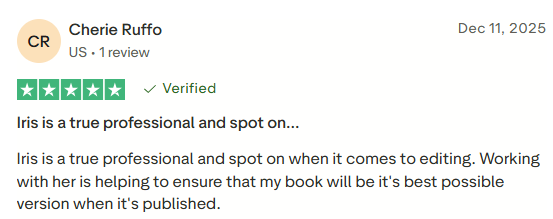
"Iris is a true professional and spot on when it comes to editing."
Cherie Ruffo, fantasy writer
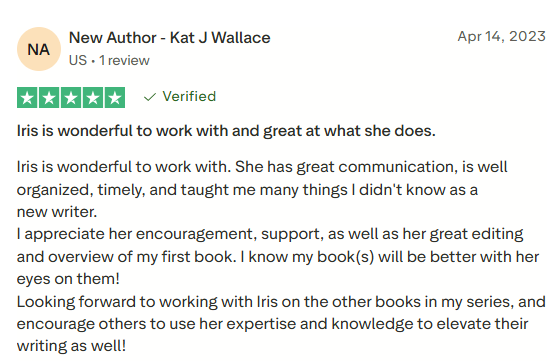
"(I) encourage others to use her expertise and knowledge to elevate their writing as well!"
Kat Wallace, fantasy author
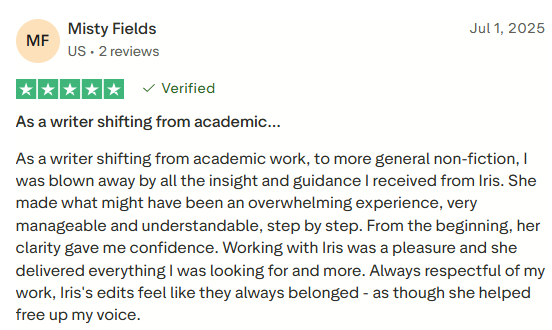
"Always respectful of my work, Iris's edits feel like they always belonged--as though she helped free up my voice."
Misty Fields, nonfiction author
What Happens When It Works
You open your manuscript and know what to look for. The revision process starts to feel less like circling the same sentences and more like working through something you understand and trust.
The techniques become part of how you write so each new draft is cleaner than the last.
When you do eventually work with a professional editor, you'll get more out of it, because you'll know what they're talking about.
And you'll feel confident sending your work out. That's not a small thing.
Is This Right for You?
A Good Fit If:
- ✓ Your draft is past the developmental stage.
- ✓ You're preparing to self-publish or query.
- ✓ You want to build a skill, not just fix one manuscript.
- ✓ You'll do the homework and submit for feedback.
Probably Not for You If:
- ✗ You're still working on plot or structure.
- ✗ You write nonfiction.
- ✗ You're looking for something that does the editing for you.
Short on Time?
The course includes a progress and planning tracker (Google Sheet) with a time-efficient option for working through the modules with one page of your manuscript instead of a full chapter.
Same system, smaller scope—everything still applies, and you still get feedback at each step.
If you're working in limited windows, this is how to get the most out of the course without spending all your time working on one chapter.
Payment Plans
Other programs that include feedback are usually open for a limited time and come with a hefty price tag. This course isn’t priced like that.
You can join any time. You get feedback from a working editor for 12+ months.
Below are 3 payment plans to make this course as accessible as possible: in full, 6 months, or 12 months. Pick whichever is right for you.
Enroll now, and you’ll receive an email with immediate access to all modules, a tracking spreadsheet, and feedback. You can submit your writing for feedback as soon as you’re ready.
Pay in Full
$397
Lifetime access to the full course (15 modules)
A complete line & copyediting system
Up to 30 rounds of personalized feedback
Guided homework
Video, PDF, and audio lessons
Launch bonuses until July 26
6-Month Payment Plan
$66 / Month
Lifetime access to the full course (15 modules)
A complete line & copyediting system
Up to 30 rounds of personalized feedback
Guided homework
Video, PDF, and audio lessons
Launch bonuses until July 26
12-Month Payment Plan
$33 / Month
Lifetime access to the full course (15 modules)
A complete line & copyediting system
Up to 30 rounds of personalized feedback
Guided homework
Video, PDF, and audio lessons
Launch bonuses until July 26
FAQ
Do I need a finished manuscript?
For the course, you'll need at least one chapter or a short story to work with. The course is most useful when the plot and characters are in place and you're ready to focus on the prose.
How does the feedback work?
You will have 30 feedback "credits" in total. This means you can ask for my feedback a total of 30 times. Each time, you will fill out a feedback form and send me a piece of your edited work (up to 500 words). You'll indicate what particular technique you'd like feedback on. I will then send you back your feedback with comments in a .docx or PDF document.
I have a full time job or am raising children. How much time do I actually need each week?
The 30-day challenge (launch bonus) is structured for one month. Outside of that, it's fully self-paced. The videos in the modules are designed to be about 15–30 minutes long. The homework will take between 1–3 hours per module. However, if you use the “fast-track” option, you can do the homework in 30 minutes per module.
Does this work for any genre?
Yes, I've created this framework to work with any fiction genre. In the first module, we'll analyze your voice. This includes anything that's particular about the genre you write in. That way, you'll know whether it's accepted to have more exposition or more internal monologue, for example.
Do you offer refunds?
Refunds are only available for the full payment of the course, within 30 days of purchase. For monthly payment plans, the plan will be canceled. See more about the refund policy here.
Will this make me an editor?
No. And it's not designed to. This course teaches you the techniques behind revising your own fiction prose. It's for writers who want to edit their own work better, not for those who want to become professional editors.
Is this course for beginners or experienced writers?
The course meets you where you are. If you're newer to writing, the personalized learning plan (launch bonus) will help you identify where to start.
If you're more experienced, the techniques will give you a clearer vocabulary and system for what you're partly doing by instinct already.
What if I fall behind in the 30-day challenge?
The challenge is a suggested structure, not a deadline. The course is self-paced—work through it at whatever speed fits your life.
Will I still need an editor after this?
A professional editor will almost always bring something to a manuscript that self-editing can't fully replicate. This course doesn't replace that, but it will make your manuscript significantly stronger before you get there, which typically means a cleaner edit, a faster turnaround, and lower costs.
© 2026 Iris Marsh Edits; Prose Revision Mastery | Privacy Policy | Terms & Conditions